Cosmic
Flux: Geiger Counter
|
Abstract
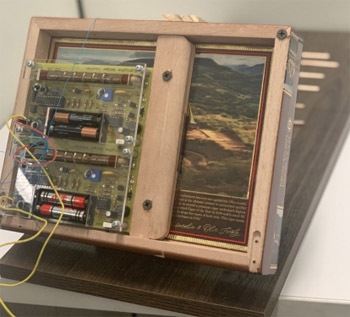
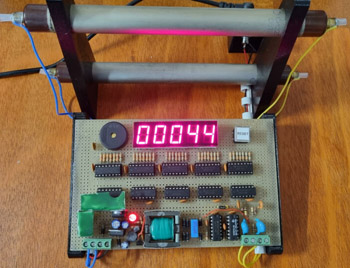
In this experiment, we built Geiger
Counters that detect various types of ionizing radiation: Beta
particles, Muons, and Gamma rays. Using the coincidence method with the
Geiger counter’s
interface, we designed a method to measure the respective flux of
cosmic radiation through a
conical range produced when the two counters are arranged in
coincidence. We calibrated the
Geiger Counter using a test source. |
|
|
CHARACTERIZING
COSMIC MUON FLUX AS A FUNCTION OF
ZENITH ANGLE USING GEIGER-MÃœLLER COINCIDENCE SETUP
in-ru
|
Abstract
The study uses a low-cost, dual Geiger-Müller (GM) tubes
coincidence detection device
in an outdoor environment to evaluate the relationship between cosmic
muon flux on zenith
angle. Coincidence occurrences decreased from 484 counts at vertical
alignment to 47 counts
at horizontal alignment, with zenith angles of 0°,
30°,
45°, 60°, and 90°. Under normal values
at sea level, the measured directional muon flux at 0° was
1.301
muons/cm²/min. An exponent
of n = 1.063 ± 0.107 was obtained by fitting the angular
dependency to a cosine power law
via a Bayesian Markov Chain Monte Carlo (MCMC) approach. The result
indicates a
qualitative agreement with a cosine-based angular distribution under
practical constraints,
despite the fact that this value is less than the theoretical
expectation (n ≈ 2). The setup
achieved a Noise Rejection Ratio (NRR) of 0.373% and a Directional
Index (DI) of 0.804,
indicating moderate directional selectivity and noise suppression. This
study demonstrates the
viability of Geiger-Müller detectors in basic cosmic ray
research
and educational contexts.
Keywords:Coincidence counts, cosmic ray muons,
Geiger-Müller
detector, muon flux,
zenith angle. |
|
|
https://www.madexp.it/2024/11/19/muon-and-geiger-counter/
|
This
project was born out of the need to create something practical and
engaging to showcase during the Open Day at the ISISS Piero Gobetti
Institute in Morciano, where I teach. |
|
|
| Educational
cosmic ray experiments with Geiger counters. |
Summary.
—
Experiments concerning the physics of cosmic rays offer to high-school
teachers
and students a relatively easy approach to the field of research in
high energy physics. The
detection of cosmic rays does not necessarily require the use of
sophisticated equipment, and
various properties of the cosmic radiation can be observed and analysed
even by the use of a
single Geiger counter. Nevertheless, the variety of such kind of
experiments and the results
obtained are limited because of the inclusive nature of these
measurements. A significant
improvement may be obtained when two or more Geiger counters are
operated in coincidence.
In this paper we discuss the potential of performing educational cosmic
ray experiments with
Geiger counters. In order to show also the educational value of
coincidence techniques,
preliminary results of cosmic ray experiments carried out by the use of
a simple coincidence
circuit are briefly discussed. |
|
|
Special
relativity in the school
laboratory: a simple apparatus
for cosmic-ray muon detection.
|
Abstract
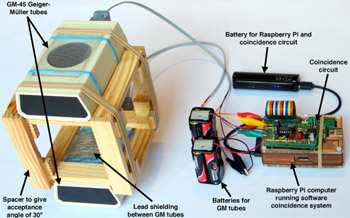
We use apparatus based on two
Geiger–Müller
tubes, a simple electronic
circuit and a Raspberry Pi computer to illustrate relativistic time
dilation
affecting cosmic-ray muons travelling through the atmosphere to the
Earth’s surface. The experiment we describe lends itself to
both
classroom
demonstration to accompany the topic of special relativity and to
extended
investigations for more inquisitive students. |
|
|
This
$100 Muon Detector Lets You Harness the Cosmos
|
In
the mid-1960s, the Nobel Prize–winning physicist Luis Alvarez
had a
wild idea. He proposed using muons,
highly penetrating subatomic particles created when cosmic
rays strike
Earth’s atmosphere, to search for hidden chambers within one of
the pyramids of
Giza. |
|
|
|
Transforming DIY Geiger
Counter Kits into Muon Detectors for Education and Scientific
Exploration.
|
Abstract
Any
Geiger counter can be used as an effective cosmic ray detector on its
own. In fact, it is known that even in the absence of a radioactive
source, the instrument detects what is known as background radiation,
which consists of various types of ionizing particles present in the
environment. Remarkably, it is estimated that up to 15% of this
background radiation is attributable to cosmic rays, high-energy
particles originating from outer space. The remaining radiation
detected by the Geiger counter originates from terrestrial sources,
such as natural radioactivity in the ground and in the air. The main
goal of this project is to build a muon detector for scientific and
educational purposes using two commercial DIY Geiger counter kits and
just a few additional components. To identify cosmic radiation from
terrestrial radiation and improve the accuracy of cosmic ray
measurements, the use of a coincident circuit is essential. This
coincident circuit was introduced in cosmic ray physics by Walther
Bothe and Bruno Rossi in the early 1930s and allows for the detection
of a subatomic particle passing through two or more sensors, thereby
reducing false positives and enhancing the reliability of cosmic ray
detection. The following idea is an alternative replica of our AMD5
detectors, instruments that we have been using for years to teach and
perform scientific experiments in the cosmic ray field under the
umbrella of the ADA project (2023 Particles, Arcani et al.). The
resulting device, named AMD5ALI, offers a reliable and inexpensive
solution for the same goal, making it a valuable tool for both
educational purposes and scientific surveys. Practical applications
range from cosmic ray physics to radioactivity, including the
relationship between cosmic ray flux and meteorology, the zenithal
effect, the Regener–Pfotzer curve in the atmosphere, and the
anti-correlation of cosmic particle intensity with solar activity.
|
|
|
|
Cosmic
ray detectors are particle detectors that use the same fundamental
principle: a particle does not become evident until it interacts with
the material of the experimental apparatus measurably or decays into
other detectable particles. This occurs through the transfer of part or
all of the energy of the particle(s) that cross(es) the detector
volume, subsequently converted into some other form more accessible to
human "perception". The type of detector will determine the form of
energy conversion. By measuring the fundamental properties of particles
(such as mass and electrical charge) and by taking conservation laws
into account, we will be able to identify particles and determine their
direction of arrival, for example. |
|
|
Investigating
the Impact of a Solar Eclipse on Atmospheric Radiation.
|
ABSTRACT
ACKNOWLEDGMENTS
TESTING
Muons are created when high energy cosmic particles like protons
collide with atmospheric molecules, such as diatomic oxygen or
nitrogen. These collisions create new molecules and decay products
such as muons. It is known that there is a relationship between muon
production and altitude.
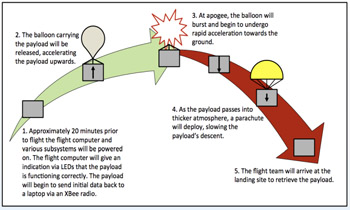
For this project, we have developed a method for the detection of
cosmic ray muons as a function of altitude. The detector is part of a
self-contained autonomous payload that is carried up to altitude
aboard a weather balloon. The payload contains a coincidence circuit
made of three Geiger-Müller tubes that make up the
actual muon
detector apparatus. This system, along with various other sensors
including internal and external temperature sensors and an altimeter,
are controlled by an onboard Arduino Mega microcontroller. |
|
|
https://www.mdpi.com/2571-712X/6/3/51
in-ru
|
Abstract
Cosmic
ray air showers are a phenomenon that can be observed on Earth when
high-energy particles from outer space collide with the Earth’s
atmosphere. These energetic particles in space are called primary
cosmic rays and consist mainly of protons (about 89%), along with
nuclei of helium (10%) and heavier nuclei (1%). Particles resulting
from interactions in the atmosphere are called secondary cosmic rays.
The composition of air showers in the atmosphere can include several
high-energy particles such as mesons, electrons, muons, photons, and
others, depending on the energy and type of the primary cosmic ray.
Other than air, primary cosmic rays can also produce showers of
particles when they interact with any type of matter; for instance,
particle showers are also produced within the soil of planets without
an atmosphere. In the same way, secondary cosmic particles can start
showers of tertiary particles in any substance. In the 1930s, Bruno
Rossi conducted an experiment to measure the energy loss of secondary
cosmic rays passing through thin metal sheets. Surprisingly, he
observed that as the thickness of the metal sheets increased, the
number of particles emerging from the metal also increased. However, by
adding more metal sheets, the number of particles eventually decreased.
This was consistent with the expectation that cosmic rays were
interacting with the atoms in the metals and losing energy to produce
multiple secondary particles. In this paper, we describe a
new–old
approach for measuring particle showers in water using a cosmic ray
telescope and Rossi’s method. Our instrument consists of four
Geiger–Müller tubes (GMT) arranged to detect
muons and particle
showers. GMT sensors are highly sensitive devices capable of detecting
electrons and gamma rays with energies ranging from a few tens of keV
up to several tens of MeV. Since Rossi studied the effects caused by
cosmic rays as they pass through metals, we wondered if the same
process could also happen in water. We present results from a series of
experiments conducted with this instrument, demonstrating its ability
to detect and measure particle showers produced by the interaction of
cosmic rays in water with good confidence. To the best of our
knowledge, this experiment has never been conducted before. Our
approach offers a low-cost and easy-to-use alternative to more
sophisticated cosmic ray detectors, making it accessible to a wider
range of researchers and students.
|
|
|
Geiger
counters offer powerful
way to teach detection methods.
in-ru
|
Educational
experiments involving the detection of
cosmic rays at sea level by simple detectors are a
powerful means of introducing high-school students
and teachers to the wonderful world of research in
high-energy physics. Recording cosmic ray intensities even by simple
Geiger counters may introduce several aspects of detection techniques
and
data analysis |
|
|
Development
of Affordable Compact Muon Radiology Camera
using Geiger - Muller Tube Arrays
|
Abstract:
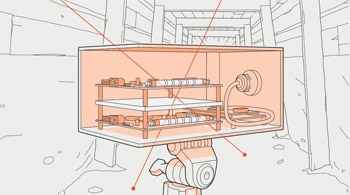
Geiger–Müller Muon Telescope in Taiwan (GMT2
) is an education program for undergraduate
students in LeCosPA, National Taiwan University (NTU), to develop an
affordable compact Muon
Radiology Camera using Geiger–Müller (GM) Tube
Arrays. GMT2
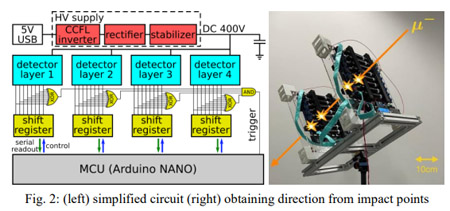
consists of two 18 cm x 18 cm identical
detector planes aligned on the axis at a distance. The arrival
direction of a muon can be obtained by
extrapolating the impact points recorded on each detector plate. The
field of view (FOV) is tunable by
adjusting the distance between the detector planes. A detector plane is
composed of two orthogonal 1-D
arrays of 8 GM tubes (L=18cm, D=22mm), providing an 8x8 grid for the
detector plane. A cost-effective
high voltage supply and readout electronics with a micro-controller
were developed for this project. A
radiograph of Leung Cosmology Hall building at NTU was successfully
taken as the first demonstration of
this project. In this presentation, we describe design, production,
calibration, as well as simulation studies.
Future prospects are also discussed. |
|
|
Development
of Affordable Compact Muon Radiology Camera
using Geiger–Müller Tube Arrays
|
Abstract:
Geiger–Müller Muon Telescope in Taiwan (GMT2
) is an education program for undergraduate
students in LeCosPA, National Taiwan University (NTU), to develop an
affordable compact Muon
Radiology Camera using Geiger–Müller (GM) Tube Arrays. GMT2
consists of two 18 cm x 18 cm identical
detector planes aligned on the axis at a distance. The arrival
direction of a muon can be obtained by
extrapolating the impact points recorded on each detector plate. The
field of view (FOV) is tunable by
adjusting the distance between the detector planes. A detector plane is
composed of two orthogonal 1-D
arrays of 8 GM tubes (L=18cm, D=22mm), providing an 8x8 grid for the
detector plane. A cost-effective
high voltage supply and readout electronics with a micro-controller
were developed for this project. A
radiograph of Leung Cosmology Hall building at NTU was successfully
taken as the first demonstration of
this project. In this presentation, we describe design, production,
calibration, as well as simulation studies.
Future prospects are also discussed. |
|
|
The
Roland Maze Project; Single Muon Flux
Measured with the GM Telescope.
T. Wibig∗‡
, R. Kołodziejczak∗† R. Pierzynski ´
∗†
and R. Sobczak†
∗A. Sołtan Institute for Nuclear Studies, Cosmic Ray Laboratory,
POB-447, 90-950 Łod´ z-1, ´ Poland; (
‡Univ. of Łod´ z), ´
†XII LO im. Stanisława Wyspianskie ´ go, Łod´ z,´
Poland.
|
Abstract— The group
of high school students (XII Liceum) in
the framework of the Roland Maze Project build the compact
telescope of three Geiger-Muller ¨ counters which allows students
to perform serious scientific measurements concerning single
cosmic ray muon flux on the ground level and below. Their work
is a excellent example of what can be done by the young people
when respective opportunities are created by more experienced
researchers and a little help and advice is given.
|
|
|
|
|
|
|
|
|
|
|
|
|
|
|
|
|
|
|
|
|
|
|
|
|
|
|